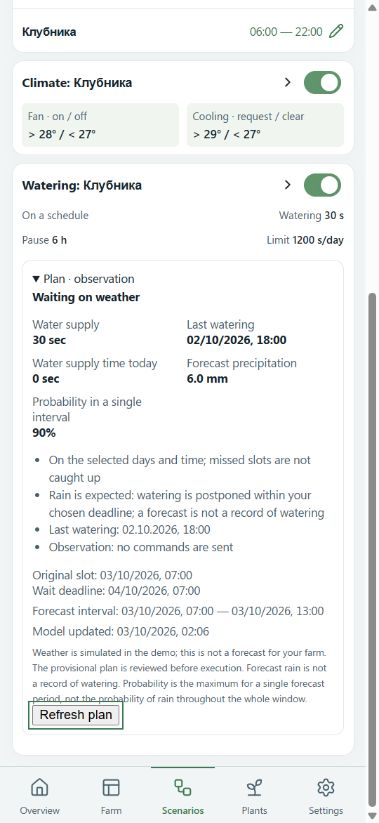
Rain-aware watering: delays with clear limits
GrowerHub can wait for forecast rain on an outdoor bed. The plan explains precipitation, delays and their deadline, while a covered greenhouse keeps its own watering rule.
Practical guides to irrigation, sensors, relays, lighting, and safe automation for homes, grow boxes, and greenhouses.
GrowerHub can wait for forecast rain on an outdoor bed. The plan explains precipitation, delays and their deadline, while a covered greenhouse keeps its own watering rule.
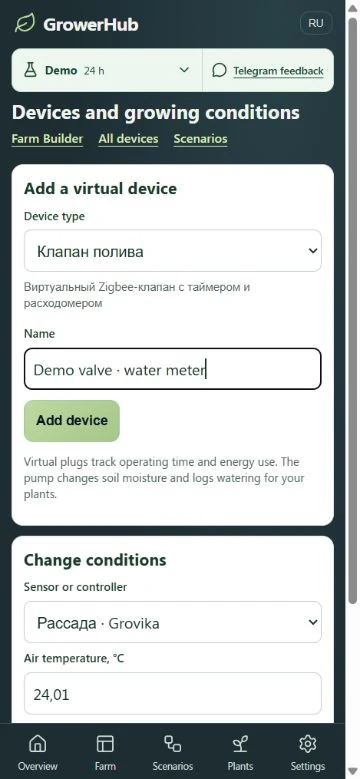
Add a virtual valve to the shared demo farm, assign it to a greenhouse and explore watering, pulses and simulated litres in the same app screens.
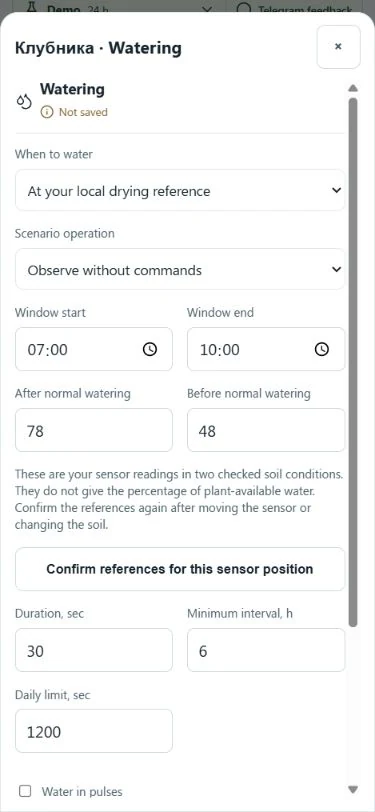
Use readings after normal watering and before the next one instead of a universal percentage. GrowerHub checks trends and response to water.
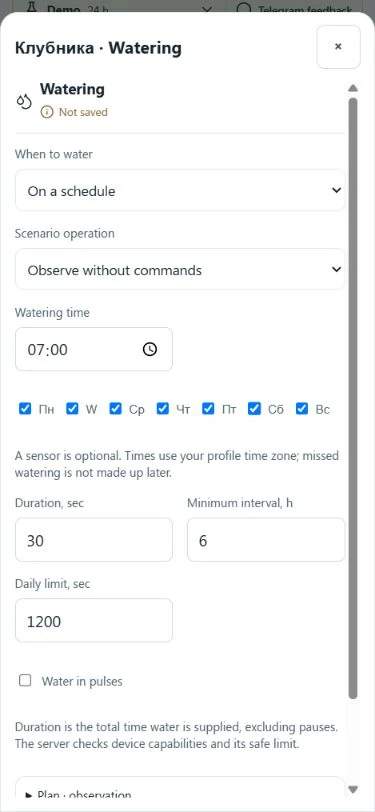
The new schedule does not require a soil sensor. Observe its plan first, then explicitly enable irrigation control when ready.
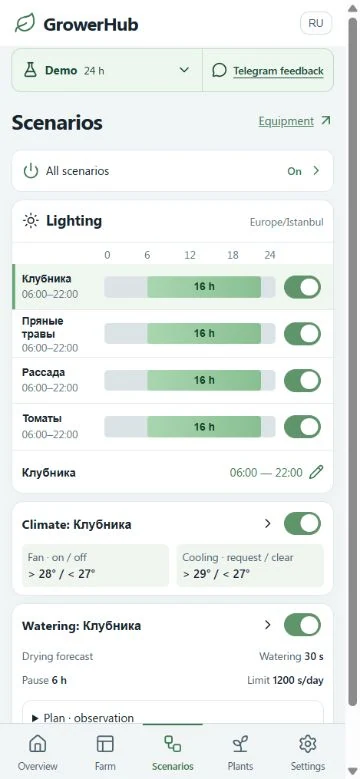
The drying forecast uses local anchors, moisture history and the last watering. It gives a provisional time or explains which data is missing.
Practical analysis of the choice of automatic watering: when a simple timer is enough, when a humidity sensor is needed, how to evaluate the pump, reservoir, tubes and overflow protection.
What restrictions should be in the automatic watering system so that a sensor error, frozen relay or leak does not turn into a problem for plants and the house.
Where to install a soil moisture sensor, how to calibrate it in the actual substrate, recognize faulty data, and build a safer watering rule.
Which microclimate parameters should be monitored first, how to read graphs, and when automation really helps plants.
How does a timer differ from an irrigation controller, in which scenarios a schedule is sufficient, and where are sensors, limits, a log and emergency locks needed.
How to avoid dangerous automatic watering errors: wrong zone, wrong sensor, missing limits, leaks, old data and starting without testing.
How to choose between scheduled and sensor-based watering, why the best scenario often combines both approaches, and what restrictions are needed.
What components are needed for the first smart automatic watering: controller, pump, reservoir, sensors, leakage protection and a clear start-up procedure.
How to connect ventilation with temperature, humidity and light, where to install sensors and why the hood should work predictably.
Practical start of irrigation automation: zone, sensors, pump, limits, manual mode and first checks before autostart.
Start by defining what automation should change: a repeatable schedule, soil-moisture feedback, or controlled water delivery. Add feedback and safeguards one layer at a time instead of automating the whole system at once.
Compare a timer, sensor-based watering, and a controller by zone size and the cost of a wrong decision.
Calibrate the sensor in the actual substrate and confirm that its value represents the root zone.
Limit each run, recovery time, and daily delivery; provide leak detection and a manual lockout.
| Situation | Where to start | Why |
|---|---|---|
| You only need a repeatable time-based routine | Schedule plus manual verification | It is easy to measure delivery without relying on an uncalibrated soil sensor. |
| The substrate dries unevenly | A sensor plus a log of manual watering cycles | A useful threshold comes from your own trend, not a universal percentage. |
| Water may run unattended | Runtime limits, leak detection, and safe shutdown | No software reading replaces an independent way to stop water. |
Begin with monitoring and manual control, review the history, and enable automation only after the equipment and limits have been tested.