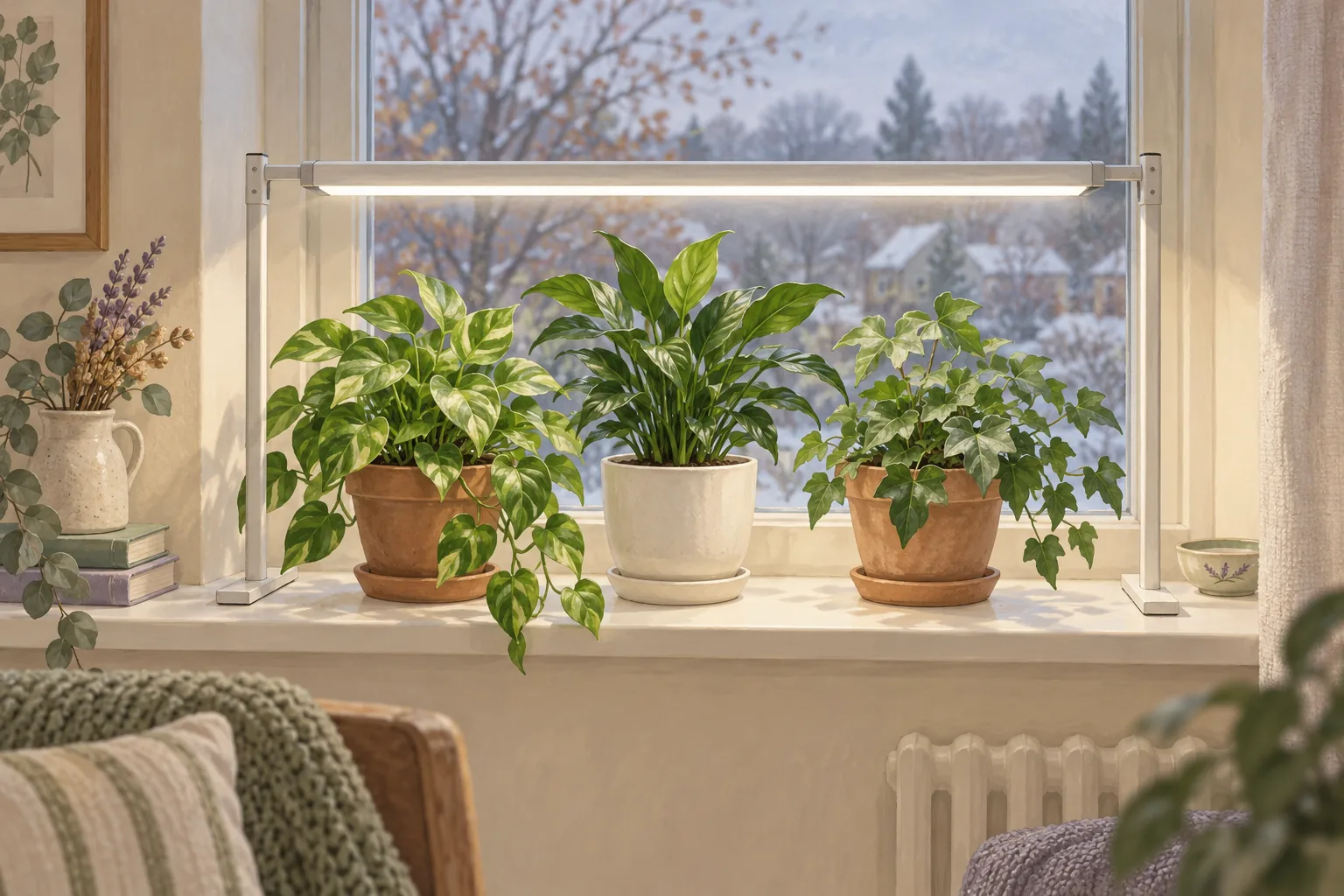
Add a light when the plant you want to grow cannot get enough light in the space available. Check the window first, then choose a fixture for the area occupied by the leaves. Buying the most powerful lamp or leaving it on around the clock does not replace that assessment.
This guide is for established foliage houseplants in a warm room. In the Northern Hemisphere, the question commonly arises in autumn and winter; in the Southern Hemisphere, use your local short-day season. Seedlings, tomato production, dormant succulents and preparing plants to flower require separate plans.
How to recognise a possible light shortage
Look at new shoots: they may stretch, leave wider gaps between leaves or lean towards the window. University of Maryland Extension describes these signs. They can suggest inadequate light, but they do not explain every yellow leaf.
Before buying a lamp, make three checks:
- Identify the plant. Find the light requirements of your particular species. Tolerating low light does not mean needing no light.
- Look at the window during the day. Curtains, nearby buildings, trees and the position of the pot affect available light. Clear a more suitable place near the window if you can. These factors are listed in Maryland's lighting guidance.
- Inspect the plant and pot. Check the growing medium, drainage and both sides of the leaves. Wet soil or visible damage deserves its own investigation. Water needs depend on the growing medium, humidity and temperature; Maryland Extension emphasises free drainage and checking the soil.
If the plant keeps a normal appearance in a suitable position, a change of season alone is no reason to buy extra lighting.
Which type of light to choose
White LED fixtures are useful options to compare for a home windowsill. Pink lighting is not essential: Iowa State University Extension discusses both ordinary white LED fixtures and dedicated grow lights. Whether a particular model is adequate depends on its output and placement.
| Option | Task and checks |
|---|---|
| General-purpose white LED bar | For a small row of plants with moderate light requirements. Check coverage, mounting stability and adjustable placement. |
| Dedicated LED grow light | For a shelf or plants needing a specific intensity. Check light data at your intended height across the whole area, adjustment and dimensions. |
| Incandescent lamp | A poor main source of supplemental light because of its heat and low efficiency compared with LEDs. |
A “grow light” label, the colour of the housing and the wattage do not tell you how much light reaches the leaves. Watts describe electricity consumption, a distinction from visible light output explained by the Department of Energy. Lumens are weighted for human vision; plants need a different assessment of light output. Iowa State's guide to light sources explains that distinction.
If the manufacturer supplies a PPFD map, check its stated height and coverage area. PPFD is photon flux density at the illuminated surface, measured in µmol/m²/s. A high central reading does not describe the edges of a shelf. The definition and effects of placement are explained in Iowa State's lighting considerations.
Before shopping, write down the plant's name, the width of your row of pots, the available mounting height and the hours when the light will not disturb people. That list makes two fixtures easier to compare than a claim that one lamp suits every plant.
How far above the plants to place it
Start with the manufacturer's stated height for your fixture and intended plants. If it is missing, ask about height and coverage before buying: a “windowsill light” label does not describe your setup. Distance affects intensity; the RHS suggests moving the source further away when light is excessive.
Position the light relative to the upper leaves, rather than the bottom of the pot. Check whether a tall plant shades its neighbours. On a long windowsill, compare the fixture's length with the row of plants; one bright spot over one pot does not cover the others.
If leaves nearest the fixture begin to look bleached after switching it on, investigate excessive light too, a sign discussed by the RHS. It also needs investigation rather than a diagnosis based on colour alone.
After installation, check that the support is stable, leaves do not touch the housing and watering will not reach the socket or cable. Follow the manufacturer's instructions for moisture, clearances and mounting. Recheck the distance as plants grow taller.
How many hours to run it
For many foliage houseplants, 12–14 hours of light per day, including window light, is a guide given by University of Minnesota Extension. Check intensity at the leaves separately.
For example, a lamp running from 8 am to 8 pm creates a 12-hour light period if the rest of the day is genuinely dark. Treat this as a schedule to assess, rather than a recommendation for every species. Preserve a dark period, a requirement discussed by Maryland Extension.
Poinsettias and Christmas cacti need an appropriate night length to flower, so do not apply a universal schedule. Minnesota Extension also notes this exception.
How to review the result
Before changing anything, photograph one new shoot and record the position, fixture height and operating hours. After a week, inspect the mounting and leaves; then compare new growth over time. An already elongated stem will not become shorter after you move a light, so the old shape of the plant is not a useful sole measure.
Change one setting at a time: pot position, fixture height or schedule. Your notes will then connect an action with an observation. A weekly check is a convenient inspection rhythm, not a promise of visible growth within seven days.
Assess watering separately. Do not automatically add water because you installed a lamp: Maryland Extension recommends checking the soil and not leaving a pot standing in water.
What the electricity use will cost
You can calculate consumption without choosing a brand: watts × operating hours per day × days ÷ 1,000.
For example, a fixture consuming 20 W, running for 12 hours a day for 30 days, uses approximately 7.2 kWh. Multiply that figure by your own price per kWh. This is an arithmetic example of consumption, not a recommended wattage for your plants.
Begin with one growing position and a clear schedule. If the conditions suit the plant and new growth is not deteriorating, there is no need to complicate the setup merely to add more lamps.
Sources and scope
Recommendations were checked on 8 October 2026 against university Extension resources: Maryland for available light, signs of a shortage and watering; Iowa State for light sources, PPFD and placement; Minnesota for light duration; the RHS for adjusting intensity; and the Department of Energy for electrical power. Links appear beside the relevant claims.
This overview is based on the sources above. The illustration shows a placement idea; use the requirements of your plant and fixture to set height and intensity.