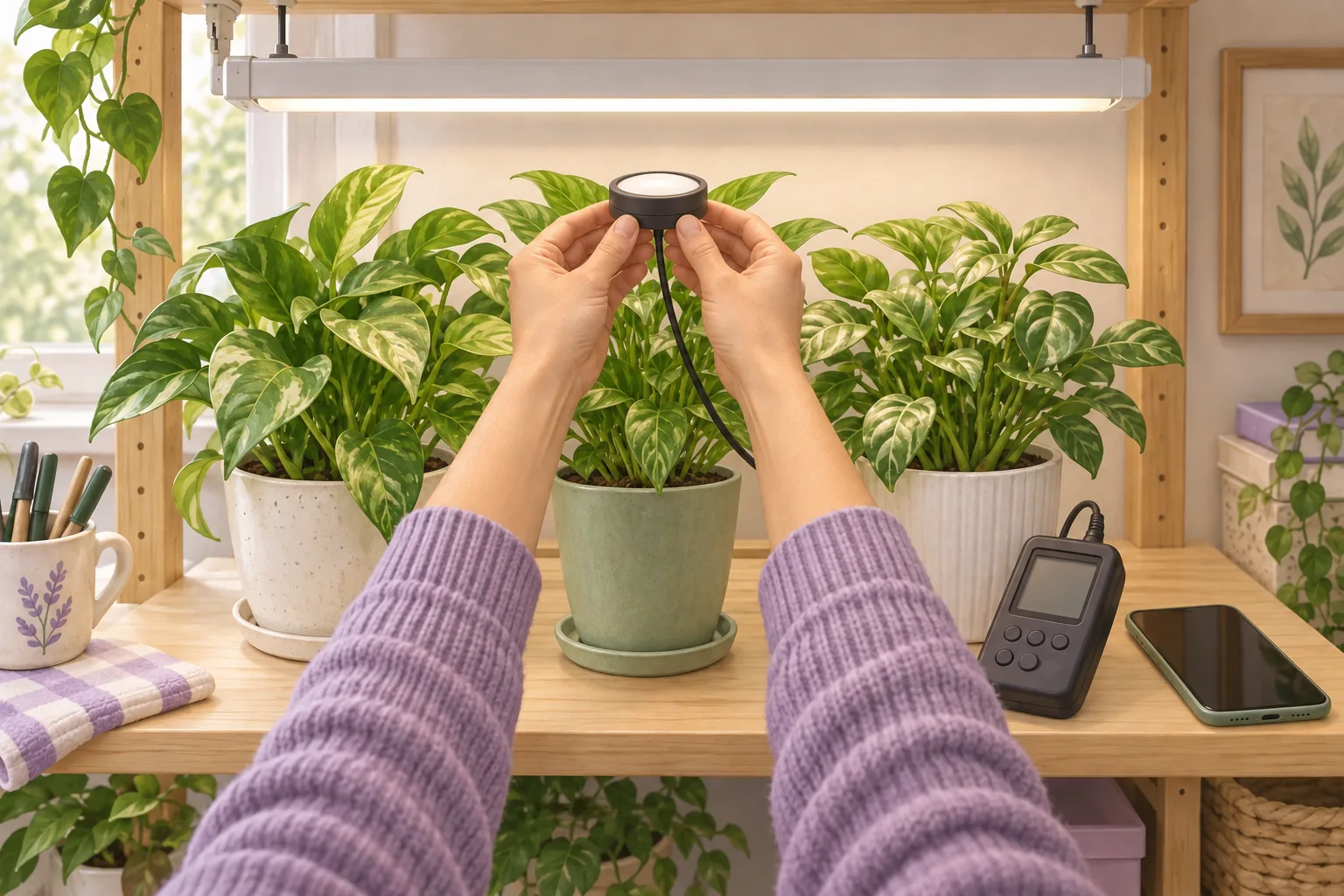
Everything looks inviting under the grow light: glossy leaves, a bright shelf, each pot tucked into its place. Yet a reading at the edge can reveal a different picture. We take in the whole shelf at once; a plant receives only the light that reaches its leaves.
A phone or a simple lux meter is often enough to explore that difference. Both can help you compare positions under one lamp. Matching light to a particular plant, or choosing between different lamps, calls for a method that measures the quantity you need for that decision.
What the numbers mean
A lux meter measures illuminance in lux, weighted to the way the human eye sees brightness. It is a useful reading for finding a brighter spot and seeing how much light falls away at the edges of a shelf.
Growing recommendations often use PPFD, measured in µmol/m²/s. This describes how many photons within a defined range of light fall on a surface each second. A reading at leaf height is useful when setting up light for seedlings, rooting cuttings or an established plant.
Lux can be converted to PPFD when you have an appropriate conversion factor for the source. Sunlight, a white LED bar and a red-and-blue lamp do not share one universal factor: their spectra differ. So two different lamps producing the same lux reading can still deliver different PPFD.
When a phone is enough
Suppose you are deciding where to put another pot: in the middle of the shelf or near its edge. There is one lamp, its brightness stays the same and daylight is out of the picture. Being able to see a consistent difference between positions matters more here than obtaining a perfect absolute number. A phone with a suitable app, or a basic lux meter, can help.
There is a simple way to check the comparison: return to the same spot. Take a reading in the centre, work around the edges, then come back to the centre. If the reading has changed noticeably, look at the receiver's position, a shadow from your hand or a change in the light. Once repeated readings settle, the comparison becomes much more useful.
A small difference lost in the variation between repeated readings is little reason to rearrange the whole collection. A consistent drop at the edge shows you which part of the shelf deserves a closer look.
Getting a phone app ready
A phone may measure with its camera or its built-in ambient light sensor. That determines which part to face towards the lamp and which settings you need.
For example, Photone uses the front camera in camera mode. Face it towards the incoming light, with the phone at leaf height. On some devices the app uses the ambient light sensor instead. You can check your mode under Light Sensor in the settings; the Photone guide explains the setup.
If the app asks for a diffuser, it is needed for that camera mode. For the paper option, the developer specifies white 80 gsm paper, also called 22 lb paper, and the matching diffuser setting. A tissue or several improvised layers will change the result. This paper diffuser is not needed in ambient-sensor mode.
The light-source profile also matters: sunlight, white LED and other options use different corrections. Choose the profile for your lamp. Availability varies with the device and version, and some profiles may require payment.
Android users can also find PPFD Meter. Its developer listing says it takes lux readings from the built-in sensor or a compatible external lux meter, then calculates PPFD and DLI. A PPFD label on the screen does not turn the phone into a quantum sensor: the estimate still depends on the original reading and the spectrum selected.
A walk around the shelf
It is easier to check the lamp in the evening, once changing daylight no longer affects the readings. Let the fixture reach its normal operating state according to its instructions. Keep the receiver clean and level, facing upwards at the height of the upper leaves. A hand or the phone itself can cast a shadow, so leave a clear path for the light.
Start in the centre, then visit the four corners of the growing area. Keep the same height and settings for this map. If your plants vary greatly in height, follow the general map with separate readings at the upper leaves of the tall and short plants.
Write down the readings with their units, the fixture height and its brightness setting. Even a sketch of the shelf on paper can show the distribution. Return to the first spot for another reading to check that conditions stayed steady during your walk.
Now you can raise the fixture a little or move one pot, then revisit the same points. Changing one thing makes it easier to see where the difference came from. To explore window light separately, take daytime readings with the lamp switched off, noting the time and cloud cover.
When a PAR meter is useful
A phone helps you get to know your shelf. The next choice depends on the decision you want to make.
Matching light to a particular plant. First find a recommendation for its species and growth stage, then check the units. A PPFD range needs a PPFD reading. A properly configured app can provide an initial estimate; its reliability depends on the phone, mode and source. Near the edge of a recommended range, measurement error could change your decision to increase or reduce light. Checking the same spots with a calibrated PAR meter is useful here: it reveals any substantial disagreement under your own lamp.
Comparing lamps with different spectra. Use a quantum PAR meter with suitable specifications for those sources. Lux readings and an arbitrary conversion factor can produce a misleading comparison. Match the measuring ranges too: conventional PAR covers 400–700 nm, while ePAR covers 400–750 nm. Readings over different ranges can diverge particularly when far-red light is present.
Setting up several shelves or a small nursery. An error now affects dozens of pots. One portable calibrated meter lets you walk the shelves and build light maps; a separate sensor beside every plant is unnecessary for that job. Look at its accuracy specification, suitability for your lamps and calibration requirements. Keeping the receiver in good condition and checking it as instructed helps preserve the value of those readings.
Before ordering, check what is included. A PAR meter with a display is ready to show a reading, while a separate sensor head may need a compatible readout device.
How much light arrives over a whole day?
A single reading is like a glance out of the window: it describes that moment. Midday sunshine, an overcast evening and a lamp after sunset give different pictures. DLI, measured in mol/m²/day, describes the accumulated light over a day.
With a lamp running at constant brightness, you can estimate its contribution from PPFD and operating hours. Window light is trickier. A few scattered readings do not replace measurements recorded at regular intervals as the light changes. A meter that logs those readings is useful when your aim is to find the actual daily DLI.
For a larger installation, electricity use belongs alongside the light map. Calculate it from power consumption and operating time, or measure it with an electricity meter. PPFD alone does not tell you the electricity use in kWh.
Your first light map is worth keeping. Next time you adjust the fixture or make room for a growing collection, you will have something to compare. Leave it near the pots, keep it in your phone notes or add it to a plant diary. If you are still choosing a lamp, start with the windowsill lighting guide.