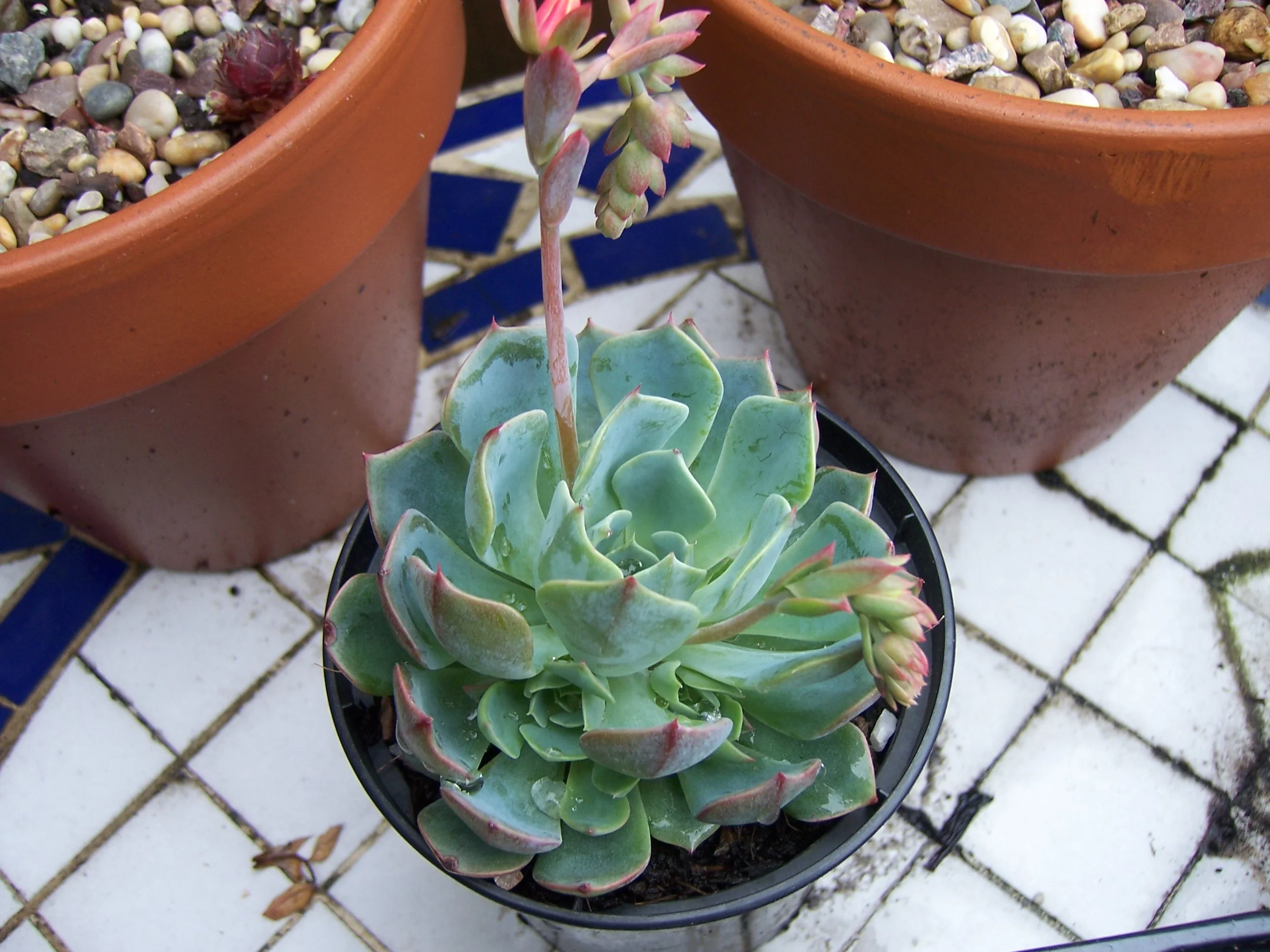
Your echeveria was a compact rosette in summer. As the days shorten, its new leaves spread apart and reach upwards. Before reaching for water or fertilizer, check how much light the plant receives and whether its pot has dried.
An echeveria needs a bright position in winter, with watering guided by the potting mix. Cool conditions and weak light slow water use; a fixed monthly watering date misses that difference.
This guide is for an established, rooted echeveria grown indoors. An unrooted cutting, a lithops or a flowering Christmas cactus needs a different approach. In the Southern Hemisphere, follow your local short-day season.
Choose a position first
Move the plant towards the brightest suitable window. Check the temperature at the pot too: it can be cold beside the glass while the room feels warm. Keep leaves away from cold glass and move the plant out of freezing draughts when opening a window.
For indoor winter care, choose a place that stays above 10 °C (50 °F). Treat this as a practical lower boundary, rather than a target to cool every plant down to. If a warm room is your only option, address the light first and watch how the pot dries.
In weak light, new growth becomes pale and thin, the rosette opens and gaps develop between leaves. Fertilizer cannot fix a dark position. Increase light gradually: a sudden move into strong sun can scorch leaves. The winter lighting guide explains window light and grow lights. Its routine for foliage plants needs adjusting for an echeveria; start with your lamp's instructions and inspect new growth.
Decide whether to water
Check below the dry surface. Gently insert a wooden stick near the pot edge: a dark, damp mark shows that moisture remains inside. Compare the pot's weight with how it feels after watering and after drying.
Once the root ball has dried and the plant needs water, wet the mix and let excess water drain completely. Water the substrate without leaving water in the rosette centre. Empty the saucer or outer pot. A drainage hole lets water escape; stones in the bottom of a sealed container cannot replace it.
Let the mix dry again before watering. A cool, bright position usually needs less frequent watering than a warm spot under a working grow light. At the next check, assess this pot rather than following the watering date for its neighbours.
| What you notice | What to check | What to do next |
|---|---|---|
| Damp mix and softening leaves | Water in the outer pot, the stem base and how long the mix stays wet | Remove standing water and stop adding more; inspect roots if the base is wet and soft |
| Dry root ball and leaves gradually losing firmness | Whether the whole root ball is dry and the base is firm | If the base is healthy, water and drain |
| New leaves stretching despite adequate water | Light at the rosette | Improve light gradually and judge new growth |
Damaged roots can also leave leaves soft, so check the mix first. More water in an already wet pot can make matters worse. A single dried lower leaf on an otherwise healthy rosette does not require a complete change of care.
Check again in a week
Take a side-on photograph and note the position, mix condition and watering date. Repeat the inspection in a week: is the mix drying, what does new growth look like, and is the base firm? If choosing between positions or lamps, use the practical light measurement guide.
Pause feeding while growth is minimal. Resume when light is adequate and healthy growth is evident, following the fertilizer label. Begin by choosing a suitable place and understanding how this one pot behaves.
Sources and photograph
Echeveria care — RHS, different succulent groups — RHS, indoor care and problem signs — Iowa State University, echeverias — UF/IFAS.
Photo: stephen boisvert, Wikimedia Commons, CC BY 2.0. Compressed as WebP without cropping or retouching; photographed at Winterbourne Botanical Garden in June 2010.
