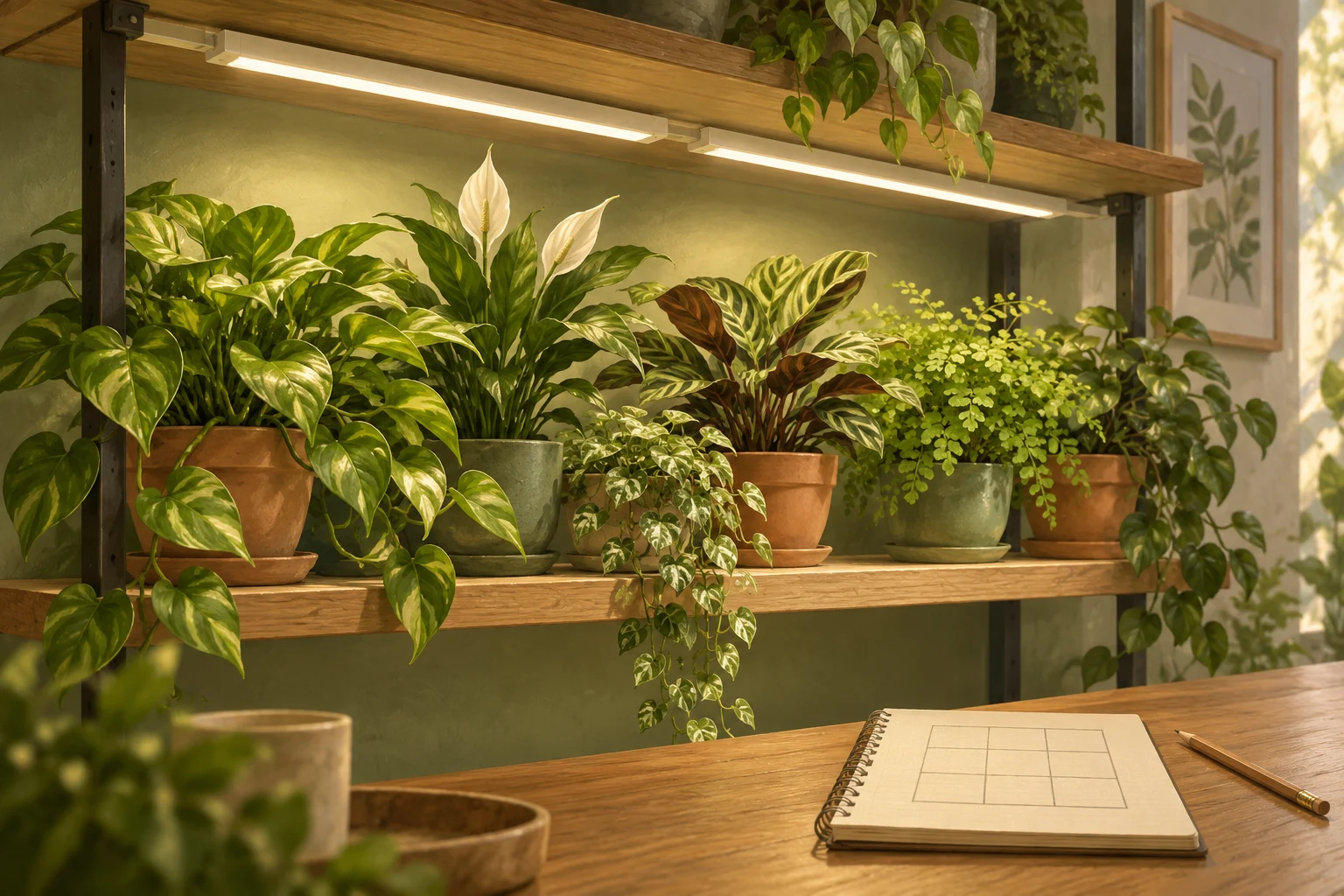
There is finally room on the shelf for everyone: a small rosette, the cuttings you could not bear to throw away, and one more pot from the windowsill. All that remains is to hang a light. The listings make the choice look simple: length, watts, a lovely photograph of greenery. Later, you may discover that the centre is brightly lit while the last row receives much less.
It helps to choose a grow light for a particular shelf: its length and depth, the space above the leaves, and the plants that will live there. Electrical input power helps you work out energy use. A light map at a suitable height helps you see whether the light will reach the whole collection.
Measure the space first
Take a tape measure and note three dimensions: the length of the shelf, its depth, and the space above the highest leaves. Allow room for the fixture and its mounting hardware. An attractive map made at a generous hanging height tells you less about a tight shelf where the fixture can only sit a short distance above the plants.
Next, write down what you intend to grow there. Rooting cuttings and an established sun-loving plant may need different conditions. With a mixed collection, work out which plants can share a space and which may need another spot. That gives the choice a useful starting point, without searching for one wattage to cover every plant.
What the watts tell you
Look for the electrical input power of the complete fixture at the brightness setting you plan to use. This describes its electricity demand. An “equivalent to 100 W” label is a comparison whose meaning needs checking; use actual input power when estimating energy use.
Two fixtures with the same input power can deliver different amounts of light to the leaves. Both total output and its distribution matter. These three specifications answer different questions:
| Specification | What it tells you |
|---|---|
| Input power, W | How much electrical power does the complete fixture draw at this setting? |
| PPF, µmol/s | How many photons within the stated wavelength range does the fixture emit each second? |
| PPFD, µmol/m²/s | How many photons in that range reach each square metre at leaf height per second? |
You may also see photosynthetic photon efficacy, PPE, in µmol/J: photon output per unit of electrical energy used. Compare figures for complete fixtures and the same wavelength range. A specification for an individual LED does not describe the finished light with its power supply and optics.
Look towards the edges
A PPFD map is a plan view of the growing area, with readings at several positions. A useful map gives the dimensions of the measured area, the distance between the fixture and the measurement plane, and the brightness setting. Match those conditions when comparing two models. Surrounding surfaces matter too: measurements in a reflective enclosure may differ considerably from an open plant shelf.
Find the positions of your outermost pots on the map, then look at the centre. A large central figure looks impressive in a listing, but cannot describe every position occupied by plants. Even an average can conceal a dim edge.
If the light falls mainly into a narrow patch, consider a different fixture shape or a layout using several bars. Check a map for that particular arrangement: two fixtures still need suitable positioning. For a long shelf, comparing a few workable layouts is more helpful than deciding by their combined wattage alone.
A useful question for the supplier
You can keep the message brief: “My shelf measures this much, with this much space above the leaves. Do you have a PPFD map for this model at a similar height? What brightness setting and surrounding conditions were used?”
Also check the fixture dimensions, mounting method and input power at your intended setting. Without a map, uniformity is harder to judge beforehand. Clear return terms and the opportunity to check the fixture after installation become particularly useful.
Once the light is home
Follow the manufacturer's mounting instructions, including clearances and suitability for moisture. Then check the light at leaf height in the centre, near the edges and between pots. A basic lux meter can help compare positions under the same fixture; comparison with a PPFD recommendation needs a suitable measurement method. The guide to your first light measurements explains the choices.
Keep the plan with the hanging height and brightness setting. As the plants grow, or another row of pots arrives, it will help you see what has changed. For the amount of light received over a day and the effect of operating hours, see the guide to PPFD and DLI.
You can begin with one small step: measure your shelf and find a map for one fixture that could fit it. A tempting purchase then has a clear place in your home, and each pot has a place in its light.