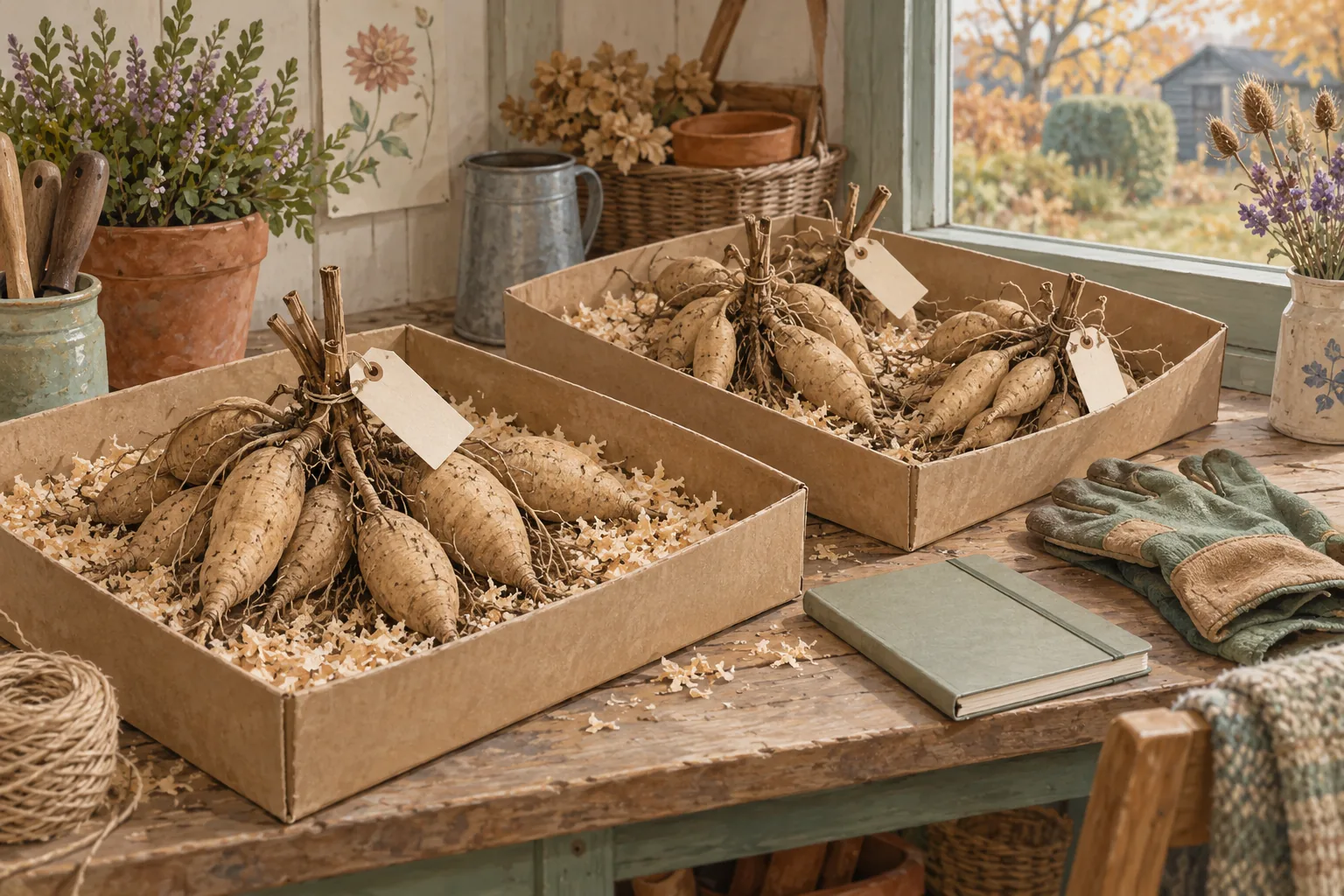
In a garden with freezing winters, dahlias are usually lifted and their tubers stored where they cannot freeze. Prepare the space, containers and labels before lifting: that makes the stock easier to identify and inspect later. The RHS describes this overwintering option.
This approach is for garden dahlias, not tulip bulbs or begonia tubers. Use your local weather; October in Russia or November in Britain is not a universal deadline. In the Southern Hemisphere, follow your own autumn and frost season.
When to lift dahlias
Foliage damaged by the first frosts is a guide in the RHS growing advice. Leaving tubers in the ground is sometimes an option in a mild climate with freely draining soil, but an unexpectedly wet or harsh winter remains a risk. Do not transfer that approach automatically to a garden that freezes.
Check the forecast and plan the work before the ground freezes. When weather deteriorates, a fixed number of days “after the first frost” is less useful than assessing the conditions.
Preparing tubers after lifting
- Attach a label before separating plants. Record the cultivar or your own number if its identity is unknown. Do not guess a name from a remaining flower.
- Cut back the top growth. The RHS guide leaves stems 5–15 cm (2–6 inches) long.
- Loosen the soil on all sides. Lift the tuber clump carefully. Cornell Cooperative Extension describes careful digging with clearance around the stem.
- Protect the connections. Do not pull tubers off by their thin necks. A division needs a piece of crown with an eye, as explained by the American Dahlia Society. If you cannot identify eyes, avoid turning the clump into a collection of detached swollen roots.
- Let the surface dry. Iowa State describes washing off the soil and drying until the surface is dry to the touch. The duration depends on conditions; a fixed “24 hours for every tuber” does not replace inspection.
Inspect the stock before packing it together. Set questionable clumps aside and investigate the damage. Iowa State's overwintering overview emphasises removing rotting material.
Storage temperature and location
Iowa State University Extension describes cool storage at 40–50 °F, approximately 4–10 °C, in boxes with vermiculite or wood shavings. Dried clumps are placed upside down. Use that range to assess a location, rather than as a guarantee for every cultivar.
| Location | Checks to make first |
|---|---|
| Basement or cool storage room | Temperature beside the box, dampness and access to each clump. |
| Garage or enclosed porch | The minimum temperature during cold weather. A room name does not establish frost protection. |
| Balcony | Actual overnight conditions and an alternative location. Glazing alone does not prevent freezing. |
When choosing a location, Iowa State warns that a living room may be too warm and a garage may freeze. Measure where the box will stand, rather than only at the door. An accessible location is more useful than elaborate packing that you hesitate to open until spring.
Keeping names and checking the stock
Keep the name on a label and in a note with the box number. Cornell Extension recommends labelling selected plants with cultivar names and growing notes. For an unidentified cultivar, an honest “dahlia 3, pink” is more useful than an invented name.
Inspect about once a month; the American Dahlia Society recommends removing rotting material. Record the date, condition and any change in storage. If tubers shrivel, assess moisture in the packing medium: the stock must neither freeze nor lose moisture unchecked.
A short pre-winter checklist
- Each clump has a readable label and a record of its location.
- The material has been inspected and the surface has dried.
- Conditions have been checked beside the stock, with access for another inspection.
- The next inspection has a date. It is a check, not an automatic watering instruction.
Sources were checked on 8 October 2026. The guides describe different climates and preparation methods; this article offers a decision and inspection process, not a promise of complete survival. The illustration shows work organisation, not disease symptoms or an anatomical guide to division.