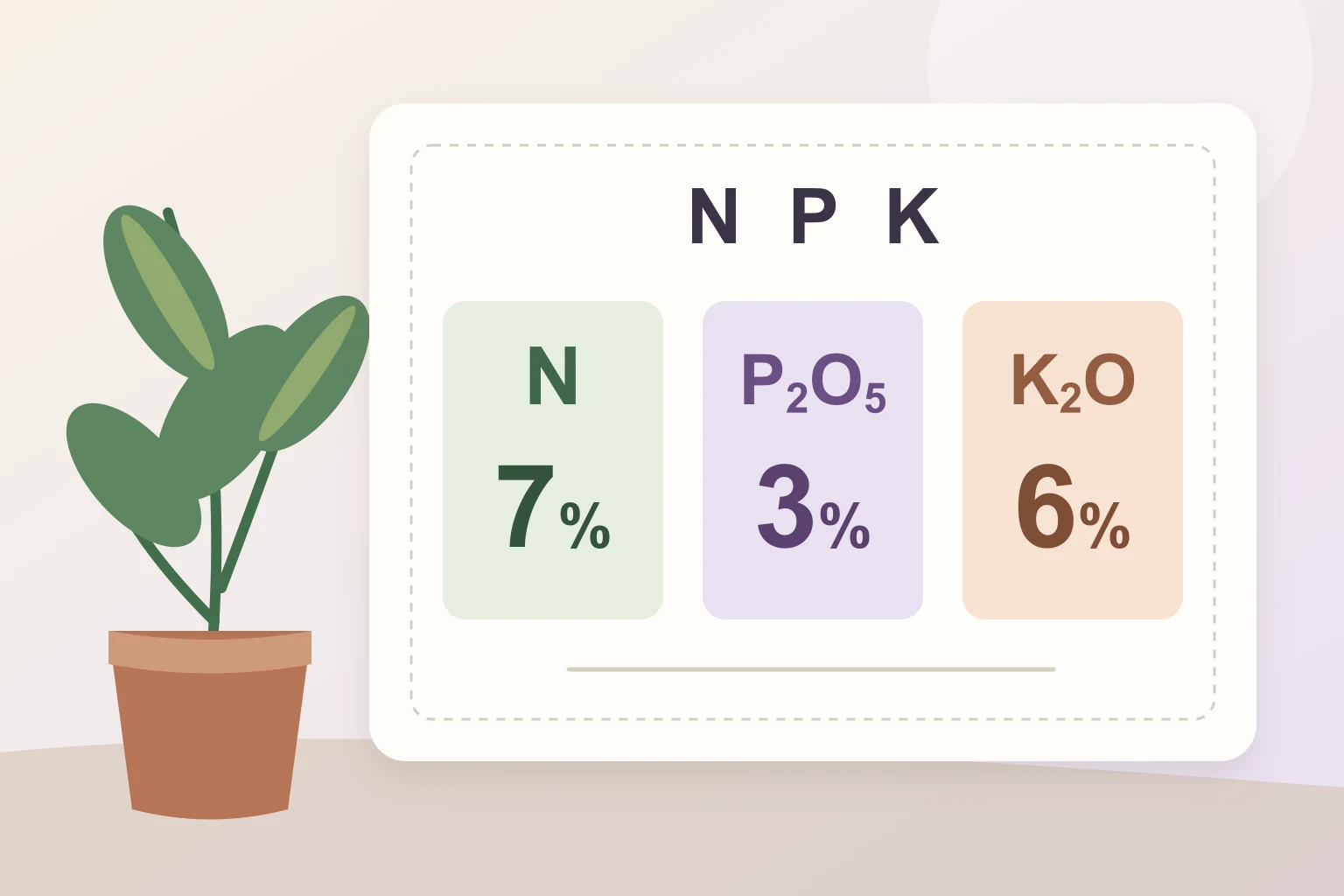
The front of the bottle shows a flourishing plant. Turn it around and there are three letters followed by a few numbers. The photograph offers a familiar wish: fresh leaves, fuller growth, flowers on a favourite windowsill. The small NPK line helps explain what is actually in the bottle.
N is nitrogen, P is phosphorus and K is potassium. The three numbers describe their content in the forms stated on the label. To prepare a feed, look next for that particular product's directions: how much to measure, how much water to use and which plants it is intended for.
Find the nutrient analysis
Look at the units and headings: percentage by weight, N, P₂O₅ and K₂O. Under that convention, an imaginary dry fertilizer marked 7–3–6 reads as follows:
| Label entry | What it describes |
|---|---|
| N — 7% | 7 g of nitrogen per 100 g of product |
| P₂O₅ — 3% | Phosphorus expressed as P₂O₅: 3 g per 100 g of product |
| K₂O — 6% | Potassium expressed as K₂O: 6 g per 100 g of product |
The 100 g here makes the percentages easy to read. The application directions tell you the portion to use for your plant.
There is a detail worth checking with phosphorus and potassium: labels often express them as the oxides P₂O₅ and K₂O. An entry of “3% P₂O₅” therefore describes a different amount of phosphorus from “3% P”. Find matching forms and units when comparing two packages.
Similar proportions, different concentrations
The grades 7–3–6 and 14–6–12 have the same proportions. If both use percentages by weight of N–P₂O₅–K₂O, the second contains twice as much of each stated component in the same mass of product.
The rest of the package still matters. Would a liquid concentrate, soluble powder or slow-release granules suit your routine? How does the manufacturer tell you to measure and apply it? Matching proportions can still leave plenty of practical differences.
Check liquid products' units carefully. Percentages by weight and grams per litre are different expressions; converting a liquid's mass into its volume requires its density. A cap from another bottle may also hold a different amount. A measuring tool and your own product's directions make the job easier.
Look beyond the three numbers
Once you have found NPK, it is tempting to put the label down. Look a little further. It may also list calcium, magnesium, sulphur and trace elements such as iron, manganese and boron.
The NPK grade does not describe the whole formulation. When choosing a houseplant fertilizer, read its full nutrient list and intended use. Find the application method too: watering, spraying or incorporation into the growing medium. Follow the directions for that method.
Match the feed to the plant
For example, a young pelargonium under a light is making new leaves, while a recently repotted moth orchid is settling into its new pot. One product might be useful for part of the collection without every plant needing it on the same day.
Check whether it suits the species and growing medium, whether fresh compost already contains fertilizer, and how the plant is growing. With yellowing or wilting, first check moisture, roots, light and recent changes in care. Similar visible signs can have different causes.
Flowering also depends on light, maturity and growing conditions. A large middle number cannot take the place of a suitable position and healthy roots.
Keep one useful record
Photograph the product name, analysis and directions while the package is handy. After feeding, note the plant, date, product, amount actually measured and water volume. Next time, you will know what went into the watering can. A simple watering log is a useful starting point.
Take your own fertilizer and find two entries: the analysis with its units, and the directions for your intended application. Those two pieces of information are a good place to begin.