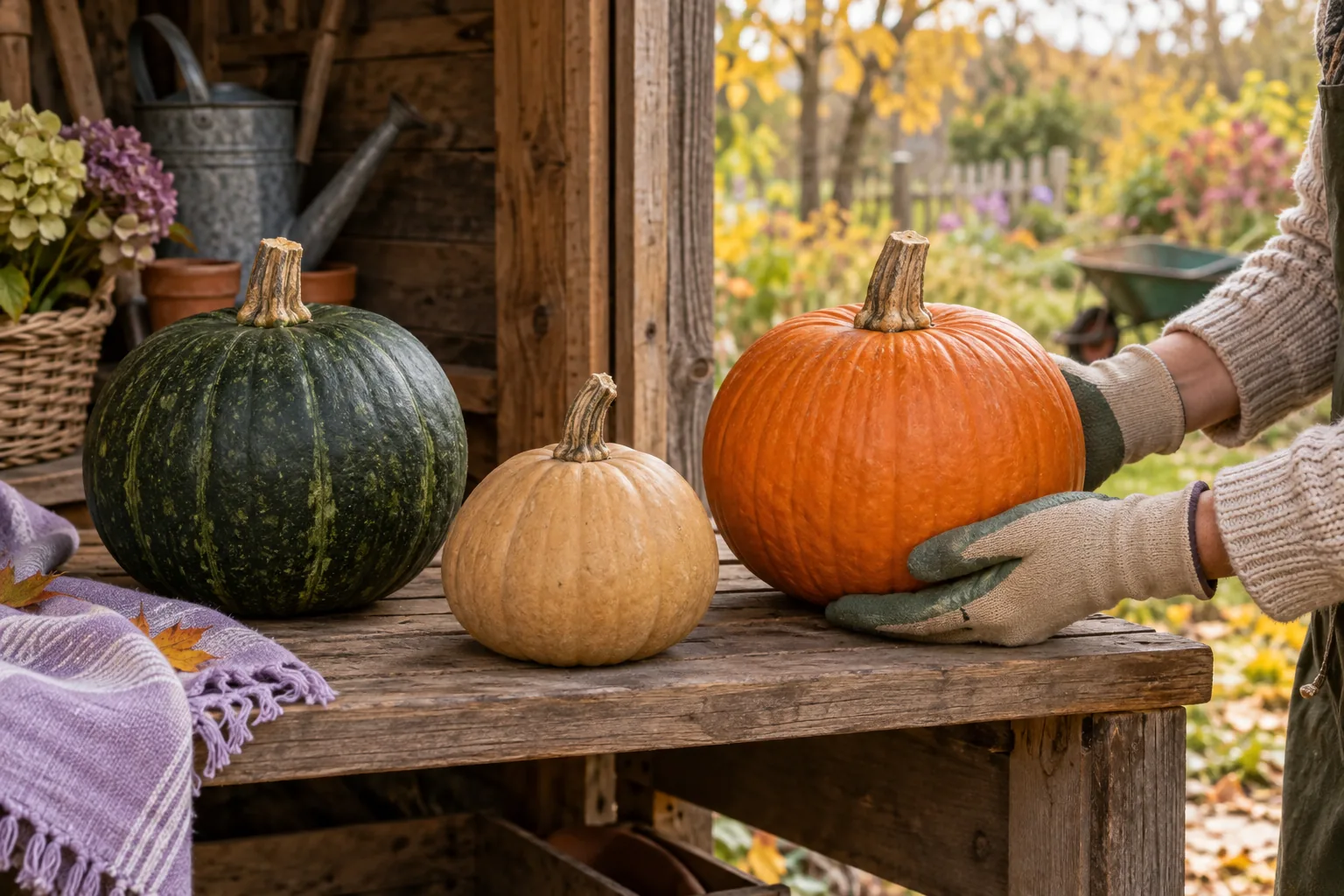
If you had to pick pumpkins ahead of frost, green skin alone will not tell you whether they can ripen indoors. Start with the cultivar and how mature each fruit was at harvest, then choose storage conditions. Very immature fruit has poorer flesh quality and is more likely to decay. For long storage, select fruit that was already fully developed and mature at harvest.
This guide is for whole edible pumpkins and hard-rinded winter squash grown for storage. Cut fruit, young summer squash and decorative gourds of unknown use need a different approach. Follow your local autumn and frost season rather than a fixed calendar date.
Green does not always mean unripe
Some cultivars keep green skin when mature. In kabocha, for example, bright green becomes duller and the stem turns corky. An ordinary orange pumpkin changes colour differently. Do not wait for every fruit to turn orange.
If you still have the seed packet, keep the cultivar name. If a friend supplied the seeds, ask whether they know it. When the name is missing, record “cultivar unknown”. That is more useful than confidently labelling a fruit from a similar photograph.
Look at the rind and stem. A hard rind and uniform colour are signs of maturity in ordinary orange pumpkins. For green-skinned cultivars, compare the fruit with its cultivar description rather than only with orange pumpkins beside it.
Sort the harvest by condition first
After an early harvest, inspect each fruit before storing everything together.
| What you can see | What to do |
|---|---|
| Intact fruit, a hard rind and a retained stem | Choose storage conditions for its type and cultivar. |
| Unknown maturity, with no visible damage | Keep it apart and observe it; do not assume the storage life of a mature batch. |
| Softening, mould or developing decay | Remove it from the stock. Ordinary warm curing will not repair that decay. |
Note the harvest date and why you picked early. “Frost was forecast” and “this fruit actually froze” are different observations. Chilling damage during storage and freezing damage are also different; a weather report alone cannot establish the condition of a fruit.
When picking the remaining pumpkins, cut the stem with a tool and support the fruit underneath. Avoid lifting it by the “handle”: the stem may break off. Protect the rind from knocks and cuts.
What curing does before storage
Curing after harvest helps harden the rind and heal small scratches. It is easy to think of it as ripening, but it is a separate step in preparing fruit for storage.
It is used for pumpkins and most winter squash, with exceptions. Acorn squash should not receive warm curing because it reduces quality and storage life. If the cultivar is unknown, establish which approach suits it first.
Choose mature, intact fruit for curing; frozen tissue will not recover through it. Fruit picked too early retains poorer flesh quality. Check temperature and rind condition: a change to orange alone does not determine suitability for long storage.
Choose a place by temperature, not its name
“I will put them in the garage” says little about the conditions. Place a thermometer beside the fruit: a balcony or garage can be much colder at night than during the day.
For ordinary pumpkins, a cool storage guide is 50–55 °F, about 10–13 °C. Guidance for pumpkins and other winter squash also gives 12.5–15 °C (55–59 °F), with adjustments for green-rinded types. Choose conditions for the known type and cultivar. There is no single temperature that suits every pumpkin.
Arrange fruit in one layer with gaps and good air movement. It is easier to inspect each fruit and spot decay that way. Long storage in an ordinary refrigerator does not suit every type: many winter squash are chilling-sensitive below 10 °C (50 °F).
Check the stock and remove fruit showing decay. A short note of the cultivar, harvest date and storage place can help you work out next season which pumpkins kept well and when to harvest them.
Further reading: maturity and storage conditions — UC Davis, harvesting pumpkins — Iowa State, and preparing different vine crops for storage. The cover is an illustration of handling whole fruit.